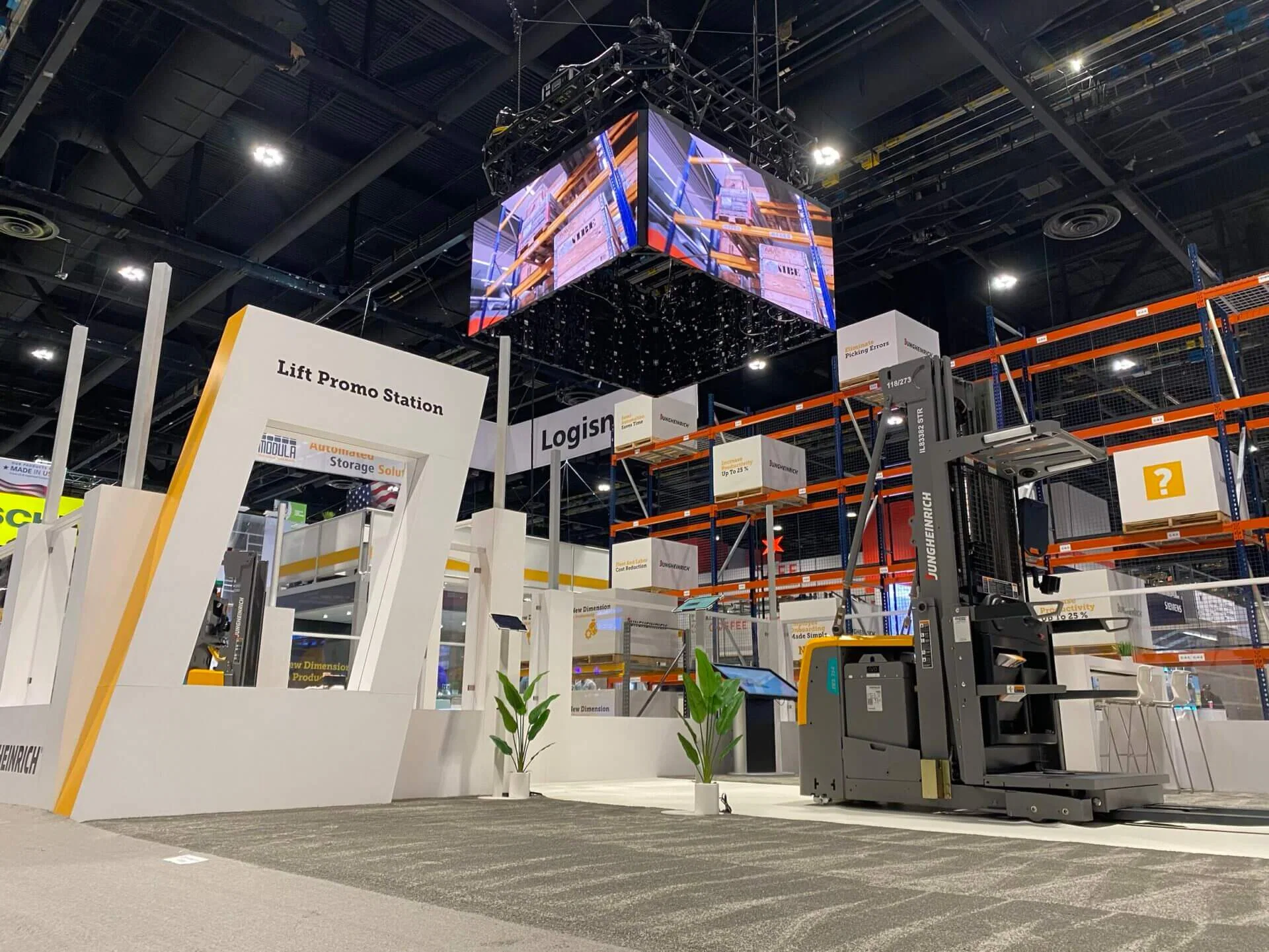
Planning Light Into the Booth
- Electrical ordered against the venue's approved provider list
- Heat and ventilation considered behind backlit fabric and LED
- LED panels aligned seam to seam with no visible gaps
- Cable runs concealed and managed for a clean look
- Content and brightness tuned to the hall's ambient light
- Early power-up so failures surface before doors open
Backlit Fabric Versus LED Video
Backlit fabric displays are the quieter of the two. An edge-lit or evenly backed frame pushes light through a dye-sublimated graphic, producing a glow that keeps imagery vivid even under the strong overhead lighting of a hall like Dallas Market Hall. They are relatively light, pack flat, and are forgiving to install, which makes them a workhorse for brand walls and headers.
LED video walls are the showpiece. Built from tiled panels, they play motion and live content and can dominate a sightline from across the floor. They also demand more: more power, more cooling, more careful handling, and precise alignment so the seams between panels disappear. The tradeoff is impact, and for many DFW exhibitors a single LED feature anchored in a backlit surround gives the best of both.
- Backlit fabric: even glow, light, easy to pack and install
- LED video: motion and live content, higher power and care
- Common pairing: an LED feature framed by a backlit brand wall
Power, Heat, and Venue Electrical
Both display types start with the electrical order. At the Kay Bailey Hutchison Convention Center Dallas, exhibitors order power from an approved provider list, so an LED wall's heavier draw and a backlit wall's steady feed should be specified and placed before move-in rather than discovered on site. Underordering power is a frequent cause of a display that flickers or fails to drive at full brightness during peak hours.
Heat is the quieter constraint. LED panels run warm and backlit frames trap some heat behind the fabric, so both benefit from a little breathing room and unobstructed airflow. Planning that ventilation into the structure keeps brightness stable and protects the electronics across a multi-day show.
Alignment, Cabling, and Show-Floor Finish
An LED wall is only as good as its alignment. Panels have to sit flush and level so the image reads as one surface, not a grid of tiles, and that calibration takes time the crew only has if the wall is built and powered early. The same urgency applies to backlit walls, where a single dim or dead zone undermines the glow the display was bought to create.
Cabling is the finishing detail that separates a clean display from a messy one. Power and data runs for backlit and LED systems should be concealed within the structure and managed so nothing crosses an aisle or shows behind a translucent panel. In an activation-style space such as Texas Live! Arena, where the room itself already carries a massive LED backdrop, a booth display has to be just as tidy to hold its own.
Backlit and LED Display Questions for Dallas Exhibitors
Q: What is the difference between a backlit display and an LED wall?
A backlit display lights a printed fabric graphic from behind for an even glow, ideal for static brand imagery. An LED wall is an active screen of tiled panels that plays motion and live content. Backlit is lighter and easier to install; LED has more impact but needs more power, cooling, and alignment.
Q: How much power does an LED video wall need at a Dallas show?
More than most static displays, and it should be ordered against the venue's approved electrical list. At the Kay Bailey Hutchison Convention Center Dallas, power comes from listed providers, so an LED wall's draw is specified before move-in. Underordering is a common cause of dim or failing screens at peak hours.
Q: Why do these displays need to be powered up early?
Because brightness problems and LED seam misalignment are immediately visible from the aisle, and both take time to correct. Powering and testing a backlit or LED wall early in move-in gives the crew room to swap a driver or realign a panel before the floor fills, instead of scrambling at show open.